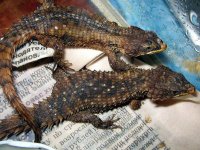
armadilo lizard

lexx

New member
does anyone keep these guys? i just started working in the reptile department at this great hobby pet store and we have some. there's an adult tank of WC animals, i've taken a liking to one of them. but there is another tank of babies that where born at the store an i've also taken a liking to one of them.

i was just wondering if anyone has some at home and what you think about them. how you keep them and such and such :)

i think they're cute and to be honest i want almost all the reptiles i'm looking after at the store but i only have room for a few so i'm trying to choose wisely.

lexx
 
Hello Lexx!

I keep 2 species of Cordylus.
Ask me what do You want to know and what species do You have?

The keeping conditions varies and depending on the species... Some are terrestrials, some are rupicolous, some arboreals, some live communally, some not...
 

lexx

New member
hello Mikhail :)

well first off i did a little research and i realized they have been misslabled they are actually dwarf sungazers - Cordylus tropidosternum -
1. how large do they get i read about 9" they largest at the store is about 5"
2. do they live in family groups? the ones at the store seem to be group orientated BUT one did give birth, 4 babies and she tried to eat them so perhaps they are not group animals?
3. are they arborial? or terestrial? or both? they like to climb one will even climb across the screen top, i also notice one of the juviniles will soke in the water dish, is this bad? or are they tropical and not derset animals?
i think thats all but anything else you would like to add would be good, oh one more thing how big an enclosure should they be housed in - i'm thinking 2, a juvi and a baby.
thanks :)
lexx
 
Hi Lexx!

First of all You don't have a dwarf sungazer as You think as for common name (one stupid stuff people use...) but You have the most commonly sold and kept among all Cordylus spp. It is also has the widest distribution of all others.
It is called as "tropical girdled lizard" - that should be useful for You to find the info via WWW.
As for a quick help I would tell You the following as it is the one of these only 2 species I keep and bred and which only available in Russia:
This is the most of the wet species, they need a daily misting the cage (per day) for juves and 2-3 times per week for adults. You should use a shallow water bowl as they like to drink and soack themself in the water. This species unlike most RSA species a water dependant.
I have a huge and the oldest adult female which is around 16-17 cm incl. tail, most others are around 14 cm.

Another thing You should realise that this one is an arboreal species that the proper cage must be settled as such:
5-6 cm of the partly wet substratum;
some rocks and branches to climb for;
a good hot spot around 35 Celsigrades;
good ventilation must be provided;
living plants also may be provided, not only succulent but also waterdependant if kept on the other side than hot spot;
a nice ReptiGlo 8.0 is definately is oblige together wit the 1-2 other fluorescent lamps for providing also a good measures of lux as these are active duirnal animals and they need a good insolation and level of light.

These species can be kept in groups male + 2-3 females.
I don't recomment to keep them in big colonies as the male may be aggressive to other males as well as a female into the entire group of other females that You need a large terrarium for these who are not dominant for restle...
As for the smaller You want to keep it is depend on the possibility but also note that they grow surprisingly fast - each week You would be able to note they larger in size if proper fed and get the UW they badly need of together with calcium-mineral supplemetary.

What else do You need to know, just ask me.
Good luck keeping em! These are my favs after the geckos and sometimes I think I like them more.... sorry guys-geckophiles :)

BTW. I recommend You to post a pic of adults as the other one species I house is come together under the same name as the C. tropidosternum in the same import but appears to be another one tanzanian species simpatrical to that one.
So, post the adult pics.

 

lexx

New member
thanks for all the info Mikhail! it not only helped me but it will help the animals at the stores. they have almost everything you said (except for the large tank) the only thing that i will have to change is the humidity, they are being housed in a dry enclosure. i have missted them in the past but not so much because i thought they wouldn't like it, but i will now.

i will also get some pics, i also have a sexing question. i was looking into the "adult" tank and all the animals are 5" or less, i don't think 4 babies could have come from 1 animal. the largest also doesn't look like the other. it's broader in the body. it's head is a little shorter and on it's lower jaw it has a white patch. perhaps a different species?

i'll try and get pics.
 
O.k., pics should help.
You should realize that having such a big distribution C. tropidosternum is a very polymorphic species and has at least two phenotypes coming from Tanzania as I saw here. One dodgy dealer named it as another one, as the 3d species but all taxonomic characters on these animals except some more slender appearence and a bit smaller size are the same and this is just due to a geographical variation (maybe =form) I believe.

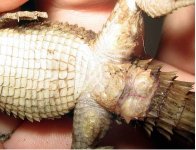
As for the sex, look here: You'll find in adult of mine C. beraducci on pic the habit of a male (below) looks different (=slight sexual dimorphism recognisable) but only if You compare the speciemns close to each other (the same like for many geckos as well) You may notice the broader head and robuster body.
But these were able to be sexed underside in classical way - well-prominent femoral pores in amales as well as the possession of 2 bulges on sides of the basal area of the tail. I found no sexual dimorphism on them based on the size.
 

Attachments

  • cord.jpg
    cord.jpg
    88.1 KB · Views: 118
Top