

moloch
New member
There is a paved road that extends west from Windorah for about 120kms before finally giving away to gravel on the Birdsville and Diamantina Tracks. This road is a great place for night driving since there is very little traffic. It also passes through a variety of habitats that alternate between red dunes, gibber flats and clay pans. Gibber flats are barren places that are covered with small stones … I think this is called "desert pavement" in SoCal. All of these habitats support mulga trees, especially along drainages. Mulgas, like spinifex, are one of the characteristic plants of the Aussie outback.
About 85km west of Windorah, the road descends a small escarpment into the Eyrean Basin. The habitats in the basin are particularly dry and mostly consists of gibber flats with cracking clay in places. Cracking clay is the home of the Fierce Snake as well as other species such as Speckled Brown Snakes and Mulga Snakes (a.k.a., King Brown Snake).
Here are a few pics of these varying habitats along the road to the west of Windorah.
Clay pans, red dunes and mulga forest in the distance.


Our first day at Windorah was hot (~40C, 104F) with a searing wind and dust storm

Eyrean Basin (85km+ west of Windorah)

Gibber flats with mulga trees


Cracking Clay. This bleak, hostile environment is the home of the Fierce Snake. Unfortunately, we could not find it on this visit and in fact, saw hardly anything here even at night. I think that the snake is probably more reliable earlier in the year when the temperatures are cooler and it must sun-bake for longer periods of time.

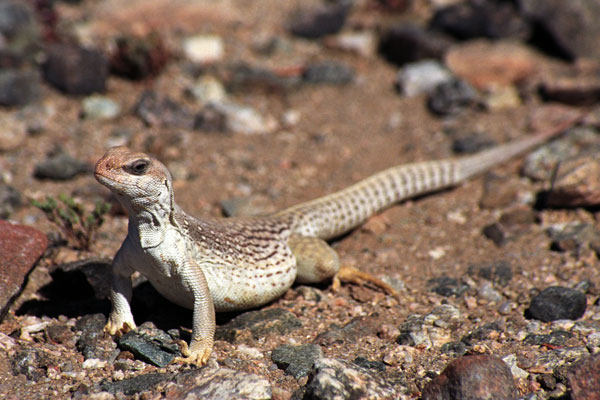
One morning, Nick decided to walk around on the flats to try and spot a Fierce Snake. He saw only a few dragons.

Tessellated Geckos (Diplodactylus tessellatus) were the most common species of gecko on clay pans and gibber flats. They vary a little in colour and pattern. Here are a number of photos that illustrate this variability.


I found two Fat-tailed Geckos (Diplodactylus conspicillatus) that looked very different to those that I have seen in Western Australia. It is hard to believe that they are the same species.
This one had a regenerated tail:

… and this one had its original tail.

Mulga trees provided cover for Northern Spiny-tailed Geckos (Strophurus ciliaris), Marbled Velvet Geckos (Oedura marmorata) and Gehyra variegata.
Northern Spiny-tailed Gecko (Strophurus ciliaris)


Marbled Velvet Gecko (Oedura marmorata)


Gehyra variegata were also arboreal geckos. They were easy to find at night on mulga trees.

While in the basin, I saw a couple of Emus that were not far from the road. I was able to hide in a mulga thicket and then began to whistle and squeak. Emus are curious birds and it did not take long before they began to approach to try and find the source of the racket.


When I stepped out from cover, they raced away.

Regards,
David
About 85km west of Windorah, the road descends a small escarpment into the Eyrean Basin. The habitats in the basin are particularly dry and mostly consists of gibber flats with cracking clay in places. Cracking clay is the home of the Fierce Snake as well as other species such as Speckled Brown Snakes and Mulga Snakes (a.k.a., King Brown Snake).
Here are a few pics of these varying habitats along the road to the west of Windorah.
Clay pans, red dunes and mulga forest in the distance.
Our first day at Windorah was hot (~40C, 104F) with a searing wind and dust storm
Eyrean Basin (85km+ west of Windorah)
Gibber flats with mulga trees
Cracking Clay. This bleak, hostile environment is the home of the Fierce Snake. Unfortunately, we could not find it on this visit and in fact, saw hardly anything here even at night. I think that the snake is probably more reliable earlier in the year when the temperatures are cooler and it must sun-bake for longer periods of time.
One morning, Nick decided to walk around on the flats to try and spot a Fierce Snake. He saw only a few dragons.
Tessellated Geckos (Diplodactylus tessellatus) were the most common species of gecko on clay pans and gibber flats. They vary a little in colour and pattern. Here are a number of photos that illustrate this variability.
I found two Fat-tailed Geckos (Diplodactylus conspicillatus) that looked very different to those that I have seen in Western Australia. It is hard to believe that they are the same species.
This one had a regenerated tail:
… and this one had its original tail.
Mulga trees provided cover for Northern Spiny-tailed Geckos (Strophurus ciliaris), Marbled Velvet Geckos (Oedura marmorata) and Gehyra variegata.
Northern Spiny-tailed Gecko (Strophurus ciliaris)
Marbled Velvet Gecko (Oedura marmorata)
Gehyra variegata were also arboreal geckos. They were easy to find at night on mulga trees.
While in the basin, I saw a couple of Emus that were not far from the road. I was able to hide in a mulga thicket and then began to whistle and squeak. Emus are curious birds and it did not take long before they began to approach to try and find the source of the racket.
When I stepped out from cover, they raced away.
Regards,
David