

You are using an out of date browser. It may not display this or other websites correctly.
You should upgrade or use an alternative browser.
You should upgrade or use an alternative browser.
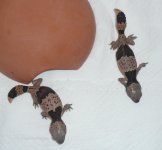
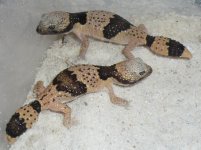
Hemitheconyx taylori F1
- Thread starter Nicolas
- Start date


Strophurus
New member
Great Succes Nic.
Fingers Crossed for the others to come out.
keep us informed.
regards stefan
Fingers Crossed for the others to come out.
keep us informed.
regards stefan




GeckoGirl1990
New member
These guys are really neat.... much more prehistoric looking than their more popular cousins!
Congrats =)
Congrats =)


cilatusguy
New member
very nice looking gecko.
congrats!
oh yeah, what is the common name for Hemitheconyx taylori. just wondering not really familiar with that species.
congrats!
oh yeah, what is the common name for Hemitheconyx taylori. just wondering not really familiar with that species.

Nicolas
New member
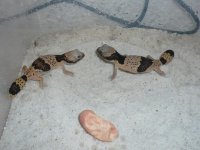
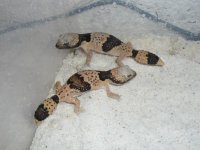
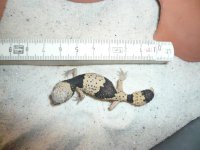
Follow up :
Incredible growing rate, sex determination seems to be possible very early (as I could see with the original group when I got them 2 years ago) ; my newborn F1 should be 1.1.
Babies taylori need help feeding as WC in first captive stage ; definitively a termite eater as some Diplodactylus.
The first meal needed 30 minutes :crackup::crackup: and each gecko ate 2 Acheta domesticus dusted with MinerAll.
Now, 1 week after the shedding they got 2 crickets every day and the help feeding only takes 2 minutes.
Incredible growing rate, sex determination seems to be possible very early (as I could see with the original group when I got them 2 years ago) ; my newborn F1 should be 1.1.
Babies taylori need help feeding as WC in first captive stage ; definitively a termite eater as some Diplodactylus.
The first meal needed 30 minutes :crackup::crackup: and each gecko ate 2 Acheta domesticus dusted with MinerAll.
Now, 1 week after the shedding they got 2 crickets every day and the help feeding only takes 2 minutes.
Attachments

MXWreptile
New member
Maybe they will eat on their own from the beginning, if they are introduced for a few generations into captivity.
Max
Max

earendel83
New member
AMAIZING ANIMALS!! Congrats Nicolas!!
I haven´t got any troubles with Diplodactylus pulcher, although in my experiencie D. conspicillatus is harder to feed...
This specie is one of my futures projects, please, keep us updated! good luck!
Regards! José R.
I haven´t got any troubles with Diplodactylus pulcher, although in my experiencie D. conspicillatus is harder to feed...
This specie is one of my futures projects, please, keep us updated! good luck!
Regards! José R.


geckofactory
New member
Really a great success, congratulations!
yours,
Fabrizio
yours,
Fabrizio