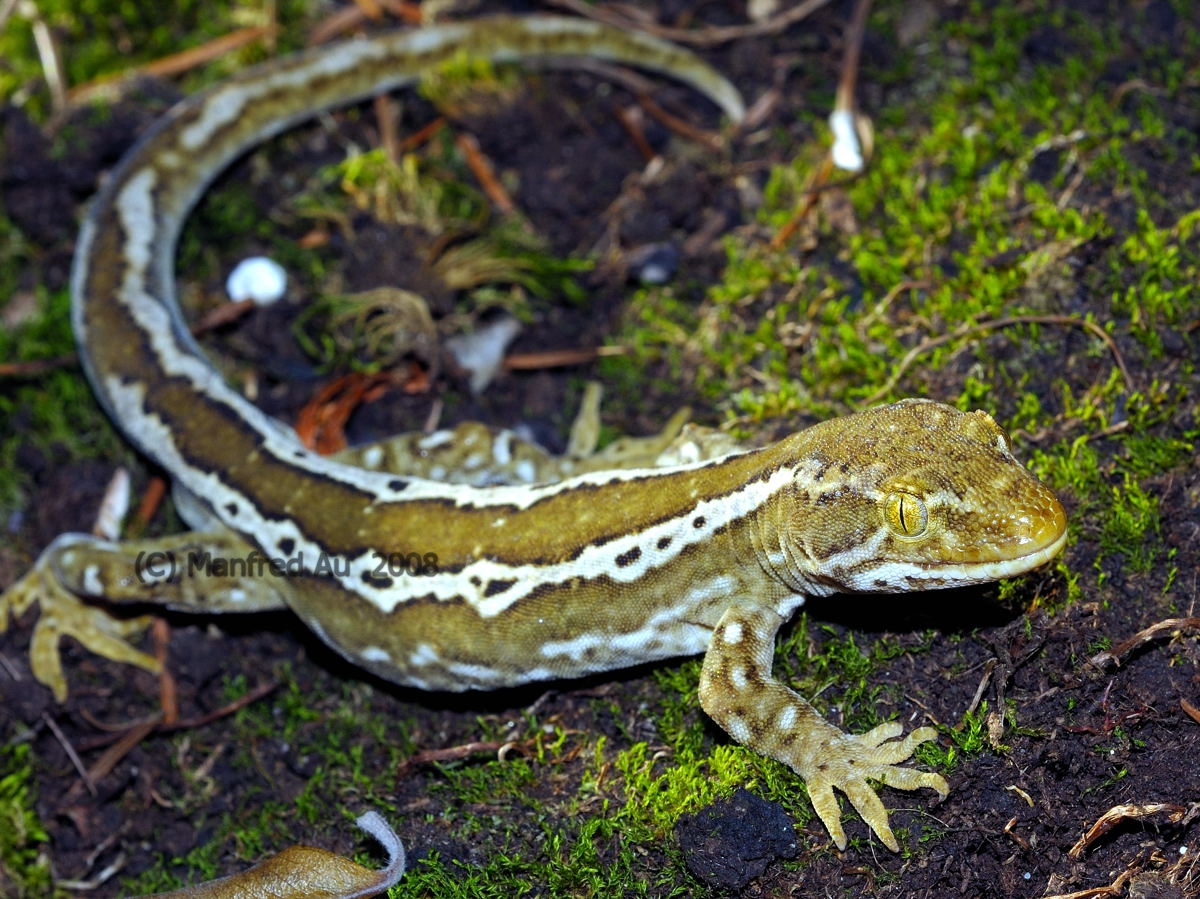
I think the gecko looks good but I honistly disagree with it being a hybrid. I think it just screws up a already amazing animal and blood line.
I think it speaks volumes of about the process of speciation in these geckos. Far from destroying, I think this cross is remarkably illuminating. Considering they are viviparous, one would expect even the most subtle differences between species in gestation time, developmental progress, and/or maternal behavior during pregnancy (different basking temperatures, activity patterns, metabolic rates) to effectively eliminate any chance of a pregnancy going full term. Thus, even small differences could serve as complete post-mating isolation mechanisms. Meaning, any time two populations experienced random changes in these parameters they would be unable to interbreed.
Evidence for my interpretation comes from a study that revealed two populations of Hoplodactylus maculatus experienced asymmetric fitness loss when pregnant females were maintained in the climatic conditions of the foreign range. The cold tolerant form was able to bear young in warmer conditions more often than the warm form could in the cold. Not quite the same as hybridization, but it suggests divergent selection between environments can facilitate genetic divergence.
Apparently, this isn't (always) the case. Now I'm left to wonder what other types of processes and isolating mechanisms contributed to the diversification of New Zealand diplodactylids.
On a final note, I agree that creating hybrids can wreak havoc on the hobby. But to say the hybridization is unnatural and hybrids are an abomination is baseless. If you feel this way, I challenge you to think long and hard about what a species is. How
should taxonomists delimitate them? How
can taxonomists delimitate them? Where should the cutoff be drawn in the continuum of divergence? What about scenarios where allelic variation from another species can be adaptive? What of the astonishing variation many genetically-homogenous species show? How are species boundaries kept intact? What of the transient nature of species?
Do they exist at all?
When I see these Frankengeckos, I see insight into the origin of some 1200 species, whose fate has become entwined with my own.