why would a leo not eat?

@marko@

New member
so ive had my leo for over 2 years now, and she was doing great up until 4-5 months ago when she stopped eating (dont worry she has eaten since then, i was trained on how to force-feed snakes and lizards). she is perfectly healthy, otherwise. great muscle definition in her hind legs, so she is must be active and receiving a decent amount of nutrition.
im baffled. if it were internal parasites, she would be showing signs of malnutrition despite my feedings, and likely be regurgitating her sheds.
ive tried crix, mealies, and wax worms and she doesnt take em.

any ideas/suggestions?
 

cricket4u

New member
so ive had my leo for over 2 years now, and she was doing great up until 4-5 months ago when she stopped eating (dont worry she has eaten since then, i was trained on how to force-feed snakes and lizards). she is perfectly healthy, otherwise. great muscle definition in her hind legs, so she is must be active and receiving a decent amount of nutrition.
im baffled. if it were internal parasites, she would be showing signs of malnutrition despite my feedings, and likely be regurgitating her sheds.
ive tried crix, mealies, and wax worms and she doesnt take em.

any ideas/suggestions?

The list of why is very long.

Read through the caresheet and compare your husbandry.
http://www.geckosunlimited.com/comm...care-recommendations-13-july-2012-update.html

Sometimes slight mistakes can make a huge difference in appetite.
 

Mardy

New member
One most common explanation for a female gecko is that they ovulate throughout the breeding season, and right now we are still in the breeding season although towards the last couple of months of it. So she could very be ovulating and even gravid, thus why she lost her appetite. There are ways to tell if she's ovulating or gravid, if you take pics of her stomach people here can help you identify.

As for you guessing on parasites, you can't guess on it. There's no way for you to know one way or the other without having a fecal exam done. It usually cost only around $30 to get a fecal done. So if you suspect parasites or even think it's a remote possibility, get a fecal exam done to make sure.

I'm not a fan of hand forced feeding unless it's for a recovering gecko too weak to hunt for themselves. A perfectly healthy looking gecko should eat when he/she is hungry. Forced feeding can be a stressful and traumatizing experience for them, stress is one of the biggest factors in a gecko having lowered immune system. And when their immune system is lowered, they are a lot more susceptible to parasites, diseases, and such.

Now if she was indeed ovulating and gravid, then there's absolutely no reason to be feeding her when she doesn't want to eat. They go through this natural cycle every single year between January and September. They often go off food, some longer than others. But they'll get back to feeding right again after they are done ovulating.

So for you, I would first stop forced feeding. Get a fecal exam to rule out parasite issues. If she checks out clean, then double check on husbandry, and leave her alone. Stress alone could cause her not want to eat, so you want to give her as little stress as possible. Good luck :)
 

@marko@

New member
The list of why is very long.

Read through the caresheet and compare your husbandry.
http://www.geckosunlimited.com/comm...care-recommendations-13-july-2012-update.html

Sometimes slight mistakes can make a huge difference in appetite.
i set up this particular tank according to an older version of that sheet. i reread it, and dont see anything in there thats distinctly different from my husbandry practices.

One most common explanation for a female gecko is that they ovulate throughout the breeding season, and right now we are still in the breeding season although towards the last couple of months of it. So she could very be ovulating and even gravid, thus why she lost her appetite. There are ways to tell if she's ovulating or gravid, if you take pics of her stomach people here can help you identify.

As for you guessing on parasites, you can't guess on it. There's no way for you to know one way or the other without having a fecal exam done. It usually cost only around $30 to get a fecal done. So if you suspect parasites or even think it's a remote possibility, get a fecal exam done to make sure.

I'm not a fan of hand forced feeding unless it's for a recovering gecko too weak to hunt for themselves. A perfectly healthy looking gecko should eat when he/she is hungry. Forced feeding can be a stressful and traumatizing experience for them, stress is one of the biggest factors in a gecko having lowered immune system. And when their immune system is lowered, they are a lot more susceptible to parasites, diseases, and such.

Now if she was indeed ovulating and gravid, then there's absolutely no reason to be feeding her when she doesn't want to eat. They go through this natural cycle every single year between January and September. They often go off food, some longer than others. But they'll get back to feeding right again after they are done ovulating.

So for you, I would first stop forced feeding. Get a fecal exam to rule out parasite issues. If she checks out clean, then double check on husbandry, and leave her alone. Stress alone could cause her not want to eat, so you want to give her as little stress as possible. Good luck :)

she is female...
i had a female leo previously, in a similar setup, and never noticed this. but im sure the behavior during this period could change dramatically.
shes never been with a male, so there shouldnt be obvious eggs in her (should there? i never bred leos, only phelsuma). ill post pics later to day just in case.
thanks for this idea. i hadnt thought of it, and if thats all thats going on, that would be great.
i dont see how she would have gotten a parasite infection, but it cant hurt to get her tested. the vet clinic i shadow at doesnt have exotics specialist, but im sure theyll be able to refer me to a clinic that does. if im going to get a fecal smear on her, i may as well get her a physical exam and hear the vets opinion.
im aware of the costs of force-feeding; and try not to do it often, and get it over with quickly. i was trained how to do it at a reptile sanctuary i was working at 3 years back, so i know im not causing any physical damage to her; but after a month of food refusal i felt the stress would be less harmful than malnutrition.
however, at this point, stopping it for a while isnt a bad idea.

ill post pics and try to get an appointment with an exotics specialist in my area.
 

@marko@

New member
What's different? Every detail counts.:) What supplements are you providing and how often?

my basking spot is currently at 98F, 3F higher than recommended by the caresheet.
instead of "rainforest type moss" in the moist hide, i have vermiculite. used peat moss at one point too. never used sphagnum (im guessing thats what is meant by rainforest type moss).

i used to feed mostly circkets, offering mealworms or waxworms for 1-2 feedings per month. more recently i fed only crickets, since there is no point in offering inferior foods for palatability when im force-feeding.
i use a mixture of tetrafauna reptocal and sandfire super foods leopard gecko dust, at about 80% leopard gecko dust, and 20% reptocal. i keep a dish of pure calcium (as CaCO3) in the cage as well. i dust heavily every other feeding.
 

brooksylc

New member
From my recent experience, please switch out the vermiculite and read the article about it on the link on that caresheet! I switched to papertowel that I have to switch out and moisten more often but is safe for my gecko.
Also you should try feeding some other feeders for variety, such as horn worms, silk worms, pheonix worms and/or butter worms. All of those are excellent nutrition and my leo loves them as treats, I swear her eyes light up when she sees anything the colour of horn worms (her favorite!)
I dont know anything about those brands of supplements, so someone else might chip in.


E's Edit: http://www.geckosunlimited.com/comm...pharis/64951-leopard-gecko-something-eye.html
 
Last edited by a moderator:

cricket4u

New member
Does you gecko actually spend enough time on 98 degrees? My geckos do not tolerate belly heat over 92. Why do you mix dusting products? and dust heavy? Stick to one brand and cut back on dusting. Does your gecko have a cool side?
 

@marko@

New member
From my recent experience, please switch out the vermiculite and read the article about it on the link on that caresheet! I switched to papertowel that I have to switch out and moisten more often but is safe for my gecko.
Also you should try feeding some other feeders for variety, such as horn worms, silk worms, pheonix worms and/or butter worms. All of those are excellent nutrition and my leo loves them as treats, I swear her eyes light up when she sees anything the colour of horn worms (her favorite!)
I dont know anything about those brands of supplements, so someone else might chip in.
thanks for the tip on the vermiculite. i new there was the risk of impaction, but not that it was actually toxic. ok thats out.
how do you keep your paper towel(s)? is it just folded up? shredded?
any opinions on large grain orchid bark? most pieces seem too large for the leo to eat, and they are not toxic fiber.

do you have a recommended source where i might be able to order any of those worms?

Does you gecko actually spend enough time on 98 degrees? My geckos do not tolerate belly heat over 92. Why do you mix dusting products? and dust heavy? Stick to one brand and cut back on dusting. Does your gecko have a cool side?
ive seen her on it before. but only at night. during the day shes either in her cool hide, or in the moist hide (which is on the warm side, but cooler than the warm hide and the area right next to it).
but its usually cooler, it just on hot days when the room temp is warmer that it can get up to 98. never seen it any warmer than that though.
i figured using the two can help in case there are any insufficiencies/overdoses in one or the other, to balance it out. i think the leopard gecko dust is better as the other one has a small dose of P. here is the analysis of the leopard gecko dust: crude protein 25%, crude fat 1.5%, crude fiber 3%, moisture 8%, ash 8%, Ca 14-16%, Vitamin A acetate 20000IU/kilo, Vitamin D3 4000IU/kilo. do you think its suitable? if not, which brand and product do you think is best?

she does have a cool side. its almost always at room temp, which varies from 76F on hot summer days, to 68F in winter; yearly average is probably 74.
 

@marko@

New member
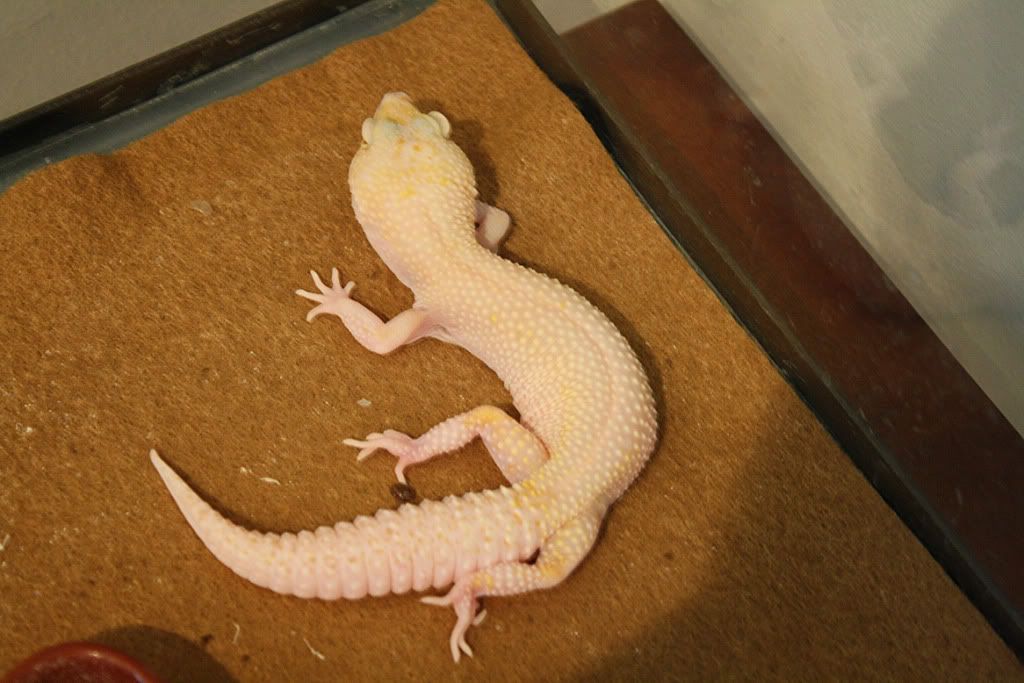
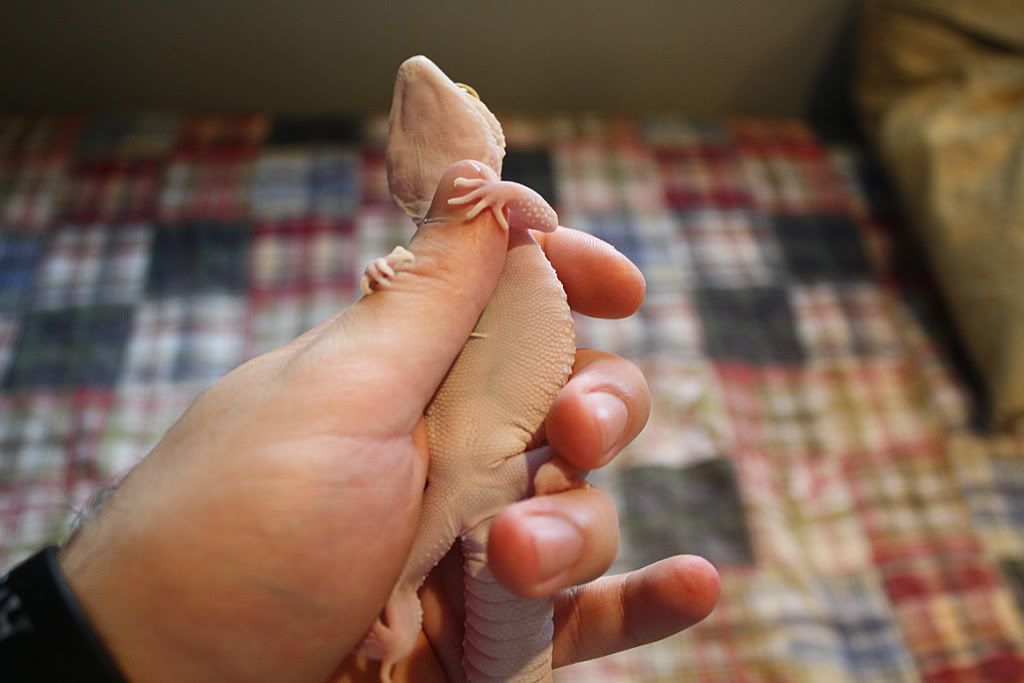
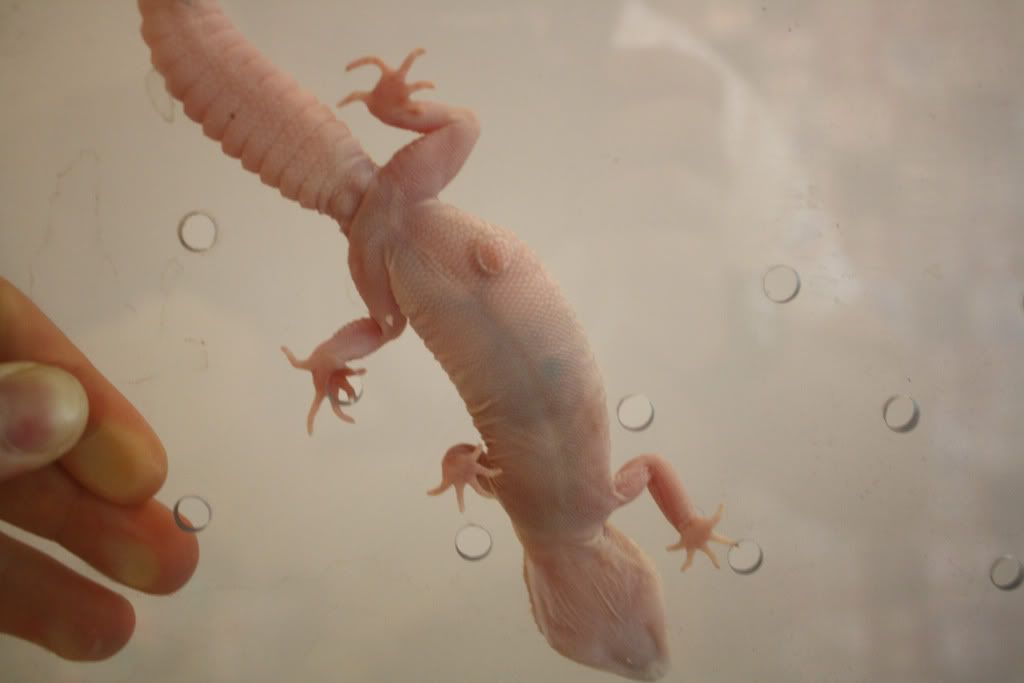
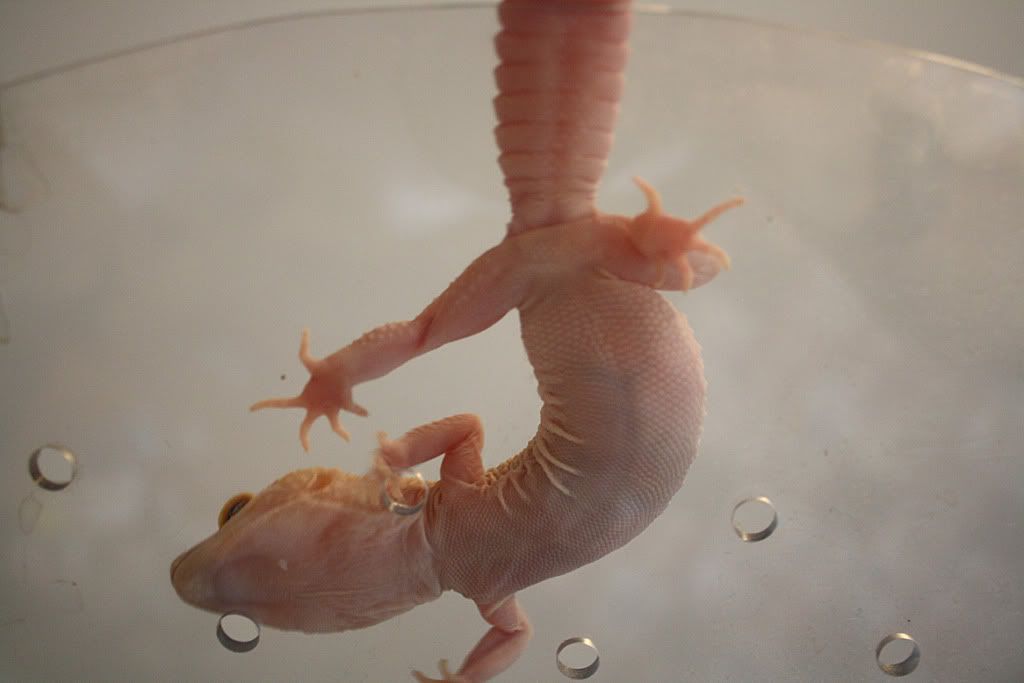
got pics:
7-27-124.jpg

7-27-121.jpg

7-27-123.jpg

7-27-122.jpg
 

cricket4u

New member
It sounds to me like the warm side is too hot. This is why you have only seen her there at night when the temps drop some. She is not spending enough time warm. Lower the warm side a few degrees. You don't have a thermostat?

As for supplements I prefer Zoo Med plain calcium and Reptivite with D3.
 

cricket4u

New member
I don't see any signs that she is ovulating or gravid. Hopefully someone with better eyesight will take a look as well. Try lowering the warm end to see if she spends more time there and maybe her appetite will return.
 
Last edited:

Elizabeth Freer

Well-known member
My recs:
Fluker's Repta+Boost for assist feeding ONLY IF your gecko is losing weight

Silkies and some other worms can be purchased at Mulberry Farms

Dampen folded paper towels for the moist hide, not shredded ones. Less chance of them being eaten.

If your humid hide has a lid (like a plastic container with lid) and with an entry hole cut out, then it will be easier to maintain the humidity within.

Hot side ground temp no warmer than 95 F maybe a bit cooler

Only lightly dust the food with the supplements

Reptile carpet is hard to sanitize. Bacteria from the pee and the poop accumulate. Leos also tend to get their teeth and claws stuck in it.
 
Last edited:

@marko@

New member
It sounds to me like the warm side is too hot. This is why you have only seen her there at night when the temps drop some. She is not spending enough time warm. Lower the warm side a few degrees. You don't have a thermostat?

As for supplements I prefer Zoo Med plain calcium and Reptivite with D3.
alright will do.
no, though i have no reason as to why i dont have one. will get one today.
now, while i will correct the heating issue immediately, the leo was doing fine in this enclosure for over a year, and then stopped eating. do you think that heat is the issue?

ok, ill try and get those suppliments in a timely fashion (no need to rush since shes not eating, and im not force-feeding any longer, as per your recommendations).

My recs:
Fluker's Repta+Boost for assist feeding ONLY IF your gecko is losing weight

Silkies and some other worms can be purchased at Mulberry Farms

Dampen folded paper towels for the moist hide, not shredded ones. Less chance of them being eaten.

If your humid hide has a lid (like a plastic container with lid) and with an entry hole cut out, then it will be easier to maintain the humidity within.

Hot side ground temp no warmer than 95 F maybe a bit cooler

Only lightly dust the food with the supplements

Reptile carpet is hard to sanitize. Bacteria from the pee and the poop accumulate. Leos also tend to get their teeth and claws stuck in it.
ill order some more variety from there then, as soon as i can get my girl to start eating.
got it, thanks.
yep mines got a lid.
working on cooling off the hot side.
gotcha, thanks.
i spot clean it as soon as i see feces, and swap it out weekly with another one and then wash it, and soak it in bleach. no issues so far with snagging claws/teeth. i will get slate tiles for my next habitat, but til then im reluctant to replace the substrate unless i see a clear issue with it.
 
Last edited by a moderator:

brooksylc

New member
I was able to find 2 locally owned pet stores that carry all those feeders plus the basics too. I would check around your city and area for stores that carry them or maybe a reptile breeder that carries or breeds them. I know most people on GU order them online.
 

@marko@

New member
ok got a thermostat. pluged my heating pads into it, and placed the temp probe on the glass, under the terrarium liner. set it to 93 F.

i was thinking id try feeding her in 3-4 days or so.
 

cricket4u

New member
ok got a thermostat. pluged my heating pads into it, and placed the temp probe on the glass, under the terrarium liner. set it to 93 F.

i was thinking id try feeding her in 3-4 days or so.

Great! Let us know if your gecko starts spending more time in the warm side.
 

Elizabeth Freer

Well-known member
ok got a thermostat. pluged my heating pads into it, and placed the temp probe on the glass, under the terrarium liner. set it to 93 F.

i was thinking id try feeding her in 3-4 days or so.


Did you mean to say heating pads? Are those pads both in the same tank?

The thermostat's probe should sit on top of the terrarium liner, right where the gecko would hang out.
 

@marko@

New member
Did you mean to say heating pads? Are those pads both in the same tank?

The thermostat's probe should sit on top of the terrarium liner, right where the gecko would hang out.
yes. i have 2 small pads instead of one large one. they are right next to each other and are the same brand. i used them like that since i had them left over.

the probe is large, bulky, and will probably pick up the air temp instead of the ground temp if placed above the liner.
 

Elizabeth Freer

Well-known member
yes. i have 2 small pads instead of one large one. they are right next to each other and are the same brand. i used them like that since i had them left over.

the probe is large, bulky, and will probably pick up the air temp instead of the ground temp if placed above the liner.


Do your two small heating pads cover the entire floor of the tank?

My thermostat probe is relatively large too. How large, how bulky? If you keep the probe where you have it, it will not actually measure the temperature where the gecko will hang out.
 
Top