New Leo owner with lots of questions!

Hello! I'm not sure if I'm writing this in the right sub-category but I'm new to this whole "forum" thing! I adopted a leopard gecko (I named him Remy) about a month and a half ago (I'll attach a picture so you can all see how adorable he is!), and I honestly don't know much about them other than what I've read online. I don't know how old he is, but he's albino and I've been told by his previous owners that he's partially blind (although I'm not sure exactly how severe it is). This is gonna be a long story so bear with me!

So I've had some minor problems in my friendship with Remy so far, but I'm trying so so hard to be a good mom! First off, I know that his tank is set up well and that I have the right lamps, etc. because his previous owner gave me his whole set up. So I don't have to worry about that! He has a day light, a night light, and an under-tank heater. He also has a cave and a log as hides. His tank is near a window but since I'm afraid that his eyes may be sensitive to light I taped black construction paper on the side of the tank that gets a lot of sunlight (which happens to be the warm side).

Because he can't see well, his previous owner told me that he doesn't eat crickets, but eats worms with vitamin powder on them out of a food bowl instead. They also mentioned that i might have to hand feed him a little bit. So I immediately went out and bought a bunch of giant meal worms (Remy's about 5 inches long so that seemed right) and tried to give them to him. Well, he wouldn't get out of his log to eat so I tried hand feeding him. He wasn't interested in the slightest in any of my worms. I continued offering them to him every evening (since they're more active at night I thought that would be best) for 2 weeks and he continued to turn me down. At that point I went out and bought some smaller meal worms thinking he'd be more interested in those, which he wasn't. So I offered him a wax worm instead, which he promptly came up and ate out of my hand. I know that wax worms aren't great for them but I was getting a little desperate. Finally a couple of weeks later he finally ate 5 giant meal worms, and has been eating 3-5 every other night since, and I've been putting them in his bowl in front of him in the hopes of familiarizing him with the food bowl. His tail is even starting to plump back up again! So finally after a month of having him he's finally eating regularly, which was a HUGE victory for us!

The only small speed bump we have in our friendship right now is that, well, he's terrified of me. He never comes out of his little log and if he starts to and he sees me he'll go right back in. I really want to handle him and get him used to me but I also really don't want to stress him out. I feel like if I try to force him out of his hide then it'll only make him more afraid, but if I snatch him up the second he leaves it then he'll want to stay there forever. His log is kind of in the middle of his tank which is probably partially why he stays there most of the time, so I thought about maybe moving it more to the cool side so that he'll get cold in there and have to leave but I'm just not sure if I should disturb him.

SO my question to whoever actually stuck through this whole drawn-out story is do you have any suggestions for me? Does it sound like I at least kind of have it together? Do you think that he'll get comfortable eventually and want to be my friend or is it a lost cause? I'm just so so fond of him but I hate the idea of scaring or stressing him!
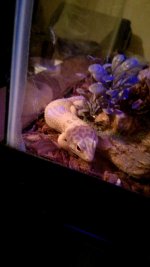
remy.jpg Look at this cutie!
 

JIMI

New member
Hello and welcome! He looks gorgeous!

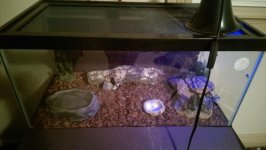
You should introduce other feeders to his diet like crickets, hornworms, phoenix worms, and silkworms. Mealworms are pretty high in fat with very little nutritional value; they are not the best staple feeder. Diet and nutrition are very important to their health. What substrate are you using? I believe I see wood chips in the photo, which is not a good substrate at all for these guys. Try using ceramic tile instead.
Some questions:
What is the size of his enclosure and how many hides does he have? Does he have a moist hide? Do you have thermometers and a hygrometer? Is your UTH on a thermostat? What are the floor temps and air temps of the hot side and cool side? What supplements are you using?

Sorry for bombarding you with all these questions! You should cover all 3 sides of the enclosure with the construction paper so that he feels more secure.

He will grow used to you with time, but sadly they will never acknowledge us as friends. :sad:They only tolerate our presence and do not have the mental capacity for affection. Handling and watching tends to stress them out so it's best to keep it to a minimum. Remember to respect his space. That's why it's best to have a dog or cat to direct all of your affection towards!:)
 
Woohoo! I love questions! They make me feel like I sort of know what I'm talking about :)

I've never heard about feeding him anything other than meal-worms, so I'll definitely look into that! I've never tried crickets but his previous owner told me that he has a really hard time catching them since he can't see too well. I also keep a carrot and some lettuce in my meal-worm container because I read that you should gut-load them. The vitamin supplement I'm using is whatever his previous owner gave me; it's called Reptivite.

I'll attach a picture of his enclosure for you so you can see just how it's laid out. The substrate looks to be Repti-bark; it was also put in by the previous owner. I'm not sure how many gallons the tank is but it looks to be about 24"x18"x12". He has two hides: one on the warm side which is a kind of cave and a long log that kind of spans from the warm to cool side. He spends most of his time right in the middle of the log. I have little sticker thermometers on the sides of the tank, above the substrate. The warm side stays about 92 and the cool stays around 75. At night he usually goes into his warm hide; I'm assuming it must cool off in there with the night light. My UTH just plugs into the wall and is built into the tank; there isn't anything attached to it other than the tank itself.

He doesn't have a "moist" hide unless I were to mist under one of them. He shed right before I acquired him so I haven't seen him shed yet but I figured that if I started to see it then I would put a moist paper towel under his cave.

I haven't handled him at all yet because I'm too scared to stress him out! I will wait until I feel like he's more secure though :) I have pretty much every other pet on the planet (horses, goats, cows, rabbits, dogs, cats....) and I work at a vet so I have plenty of other creatures to love on in the mean time! :p

IMAG0419.jpg
 

PowayRock

New member
A good mommy might have to spend some money. These guys are a little expensive. I am not gonna be much help by saying there is a preffered care sheet on this site it is extensive and with all my research your best info is here, and yet i do not know how to add the link here... sorry. Your lizard is very sensitve. Anyhow I have followed this website caresheet I am two months into it. I now have two expensive :( enclosures (had to seperate the male and female due to their age) that are beautiful. Very new myself I wish you luck Ive learned alot here fast. Heres my enclosure and it was based from the video on this sites caresheet.
 

Attachments

  • IMG_2402.jpg
    IMG_2402.jpg
    96.4 KB · Views: 32

cricket4u

New member
A good mommy might have to spend some money. These guys are a little expensive. I am not gonna be much help by saying there is a preffered care sheet on this site it is extensive and with all my research your best info is here, and yet i do not know how to add the link here... sorry. Your lizard is very sensitve. Anyhow I have followed this website caresheet I am two months into it. I now have two expensive :( enclosures (had to seperate the male and female due to their age) that are beautiful. Very new myself I wish you luck Ive learned alot here fast. Heres my enclosure and it was based from the video on this sites caresheet.

If you think this is expensive, you will fall out your chair to hear how this setup is not ideal. You will hate me then, so I will be nice and let it go. It's no secret, everyone here knows how I feel.:)

I was looking over your albums and I noticed not so healthy looking skin. I was not sure if this is how you received the leo or something may be off with diet. Do you mind me asking what supplements you use, how often and what insects do you feed?
 
Last edited:

Elizabeth Freer

Well-known member
This may be the link PowayRock speaks of:

Click: http://www.geckosunlimited.com/comm...-macularius-demo-video-4-jan-2013-update.html

To view click Leopard Gecko Setup, not the arrow:
Video: https://www.youtube.com/watch?v=GmWmvT1d_TQ#t=11

Updates to video
---No supplements in the enclosure at all
---By omitting a background your leo will have more ground space to explore. Some leos will climb a background, but then fall off and could get hurt

For an excellent humid hide click: Amazon.com : Zoo Med Reptile Shelter 3 in 1 Cave, Medium : Leopard Gecko : Pet Supplies
 
Last edited:

PowayRock

New member
The two Picts on my hand were fresh from the pet store. As of now they she'd quite frequently and are very vibrant. I will not hate you I am new any input is appreciated. The lives of my geckos are valued over pride. So I gut load cricket.... (They will not eat meal worms. ). I have a dish of flukers high calcium cricket diet. And a dish of nature zone all in one diet total bites. And I dust with reptivite once a week. My lizards seem very healthy. The male with the black was a runt and had skinny tail. He's caught up to the always large fat female. They are now equal. Oh I feed waxworms so far twice in two months. Is that okay. The wax worm was for the little male because he was skinny. I will add two fresh Picts tommorow if you'd take another look. They have both just shed. Please let me know anything more I may need to know for the diet or if you see unhealthy skin
 

Elizabeth Freer

Well-known member
The two Picts on my hand were fresh from the pet store. As of now they she'd quite frequently and are very vibrant. I will not hate you I am new any input is appreciated. The lives of my geckos are valued over pride. So I gut load cricket.... (They will not eat meal worms. ). I have a dish of flukers high calcium cricket diet. And a dish of nature zone all in one diet total bites. And I dust with reptivite once a week. My lizards seem very healthy. The male with the black was a runt and had skinny tail. He's caught up to the always large fat female. They are now equal. Oh I feed waxworms so far twice in two months. Is that okay. The wax worm was for the little male because he was skinny. I will add two fresh Picts tommorow if you'd take another look. They have both just shed. Please let me know anything more I may need to know for the diet or if you see unhealthy skin

There are more ways than one to keep leos healthy and vibrant. :)

#84---cricket4u's Customized Leopard Gecko Husbandry
---Houses her 3 mature leopard geckos separately in custom wooden enclosures
---Vivarium size: 4.5 ft x 2 ft x 2 ft, (one vivarium larger?)
---Heats those /\ enclosures with radiant heat panels
---Uses a proportional thermostat to ensure accuracy
---Provides UVB lighting via Zoo Med 18 inch Reptisun 5.0 tubes for natural vitamin D production
---Uses Exo Terra light units for the UVB that can be set for 10, 12, or 14 hours
---Provides adequate hides and cover so that her leos can dodge the UVB rays
---Cricket4u uses this UVB meter: SolarMeter 6.2 UVB
Another meter: http://zoomed.com/db/products/EntryD...I7czoxOiIwIjt9
---If you use UVB inappropriately your leo can receive too many UVB rays. Just the way we end up with sunburn from laying under the sun too long.
---Uses T-Rex Calcium Plus Food for Crickets & Mazuri as her formal gutloads
---Recommends 48 inch long enclosures as minimums for providing UVB for leos

---Uses a custom cricket feed that is made by someone she knows. She does not have the recipe.
---Suggests that "too many carrots" also binds calcium.

Cricket4u says that wooden enclosures provide these benefits:
(1) Humidity control much easier: recommends 40-50% RH for the enclosure in general
(2) Superior heat retention of wood
(3) Increased security/privacy for leopard geckos
 
Last edited:

Elizabeth Freer

Well-known member
The two Picts on my hand were fresh from the pet store. As of now they she'd quite frequently and are very vibrant. I will not hate you I am new any input is appreciated. The lives of my geckos are valued over pride. So I gut load cricket.... (They will not eat meal worms. ). I have a dish of flukers high calcium cricket diet. And a dish of nature zone all in one diet total bites. And I dust with reptivite once a week. My lizards seem very healthy. The male with the black was a runt and had skinny tail. He's caught up to the always large fat female. They are now equal. Oh I feed waxworms so far twice in two months. Is that okay. The wax worm was for the little male because he was skinny. I will add two fresh Picts tommorow if you'd take another look. They have both just shed. Please let me know anything more I may need to know for the diet or if you see unhealthy skin

Excellent on Zoo Med's Reptivite! Is yours with or without vitamin D3?

Flukers High Calcium Cricket Feed is not very effective. (Used it myself in the past. :-() Research info on post #45 following the Basic Leo Guidelines. I use Albers' All Purpose Poultry Food as my crickets' diet. If not, Zoo Med's Natural Bearded Dragon Food Adult Formula also makes a good cricket diet.

Here's a dealer locator for Albers. CA shows up: http://www.albersfeed.com/dealerLocator/?SearchType=A

What we wish is a 1.5-2.0 calcium : 1.0 ratio phosphorus in the insects we feed our geckos. Since many insects including crickets are overbalanced with phosphorus content, any food that is not at least 1:1 does not help much to rebalance the insect.

Click for guidelines including a USDA foods link: http://www.geckosunlimited.com/comm...-feeding-issues/68574-cricket-guidelines.html

Crickets are very good. Add variety too: crickets, genuine Phoenix worms, roaches, silkworms, hornworms, mealworm pupae, freshly molted mealworms, calciworms, grasshoppers, and locusts (smallest locusts possible).
 
Last edited:

Elizabeth Freer

Well-known member
Yes d3. Are you familiar with the total bites? I will look into the bearded dragon food .

Good on the Reptivite with D3. Just use a tiny pinch once per week. Alternatively dust by weight of your leos, spreading the dusted crickets over a week instead of all at once.

I have used Nature Zone's Total Bites in the past also. Albers with D3 and vitamin A acetate seems to be good. A friend of mine recommended that when I relocated to Oregon 4.5 years ago.

Click Nature Zone's: http://www.drsfostersmith.com/product/prod_display.cfm?pcatid=27600 Low in protein, high in fat, very high in fiber.

Still I would leave dampened paper towels to provide moisture for your crickets.

Albers Dealer Locator (in CA too): Albers Animal Feeds
 
Last edited:

JIMI

New member
littlemissbigcity,

He may learn to become a better hunter with time. You can also remove the hind legs of the crickets (I know it sounds cruel!) and place them in a shallow a glass bowl. Do you know if the previous owners ever took him to the vet for this issue?

Gut load is the term used for jacking up the feeders with nutrients and calcium about 24-48 hours prior to feeding off the insects. This is usually done with a formal gutload. For example, here is what I use: Hi Calcium Gut Loading Diet # 5M38 - 1 kg. I feed this to a group of crickets that I have separated from my cricket container only when I am not supplementing. Their 24/7 food items should consist of fruits and veggies that have high calcium to phosphorus ratios (This link shows the calcium to phosphorus ratios of some veggies and has several other links located on the top of the page explaining calcium to phosphorus ratios: The Iguana Den - Iguana Diet - Vegetable Cal:phos Ratios). Lettuce is not a good feed because it lacks nutrients and is made up of mainly water. I like to give my crickets a variety of different healthy veggies that Iguanaden has on their grocery list. I like to feed variety to both my crickets and leopard gecko. I switch this with a dry cricket chow every other day. For another example, Elizabeth describes above how she feeds hers.

Does the Reptivite contain D3?

It is better to have a longer enclosure (about 30 inches long minimum, 36 inches is even better. The bigger the better). He also needs to have a moist hide available 24/7 to help prevent dehydration and shedding issues. You can make one out of a plastic container. A good hygrometer is also necessary to ensure the the relative humidity stays within 40-50%

Thermometer stickers are not reliable, so it is best to have a few thermometers with probes. A temp gun is also great. You need to be able to measure the floor temperatures and the air temperatures. Since he seems to be avoiding the warm side, you should try bringing the floor temperature down to around 90 degrees. This is a thermostat: Amazon.com : Hydrofarm MTPRTC Digital Thermostat For Heat Mats : Plant Germination Heating Mats : Patio, Lawn & Garden. You plug the UTH into it, set it for a desired temperature, and it will keep the temperatures constant and safe. A thermostat is not an option.

Check out the care sheet that Elizabeth linked for more information, but if you need any clarifications feel free to ask:)

I’m jealous of your animal filled environment! :D
 
Last edited:
Ah thank you so much for all the suggestions! I never knew I was doing it wrong :) The Reptivite DOES contain D3, I made sure. I don't know for sure how the previous owners even knew that he had eyesight problems because he seems pretty normal to me, other than always being in his hide. If i put his food bowl at the end of his log he can see it and will come up to it. Loud noises also scare him and I think he's pretty sensitive to light so I try to keep my room quiet and his enclosure dark. I'm guessing that his sensitivity and "jumpiness" led to their conclusion, but I don't really know how he acted before I got him.

I did however have a couple questions about switching to the tile. I use a 75 watt heat lamp and I'm a little bit afraid that it'll get too hot and he'll burn himself. Is that a legitimate concern or am I being over-protective? :p Would it be logical to maybe put a layer of Repticarpet over it or would that be pointless? Would it make more sense to take away the bulb and just get a new UTH that would make it warm enough by itself? If I were to switch, I wouldn't need to replace it to clean the tank the way I would with the bark, so it would end up saving me money in the long run, right? Would I just clean off the tiles the way I would any other par of the tank?

One thing that I've found is that when my room is cooler he spends more time on the warm side. I usually keep my room around 69 degrees but since it's been summer and I don't have AC in my older home it's been warmer. I'll definitely have to get some more reliable thermometers and make some adjustments for that :)

If I were to keep my current terrarium for a while (poor college student, would have to save up for a new one) and get a moist hide, would you recommend maybe removing one hide so he still has two? That way the tank wouldn't get too crowded. I was thinking of maybe moving the cave to the cool side, putting a moist hide on the cool side, and maybe taking the log out altogether until I get a bigger tank.

Thanks again so much for your help!
 

JIMI

New member
No problem!

You should continue to monitor his actions and reactions to his environment. Test him with crickets, but not until you take out the repti bark. It would be a good idea to remove the repti bark now and use paper towels until you get the ceramic tiles, but I do not feel comfortable feeding crickets on paper towel because they can accidentally ingest some of the paper towel which can also cause some complications. Stick to the bowl for now.

I suggest getting zoo med's Repti calcium with D3 and plain Reptivite. The Reptivite should be used very sparingly and should only top off proper gut loading and insect feeding. Or you can take a look at Elizabeth's recommendation regarding Reptivite with D3 in post #13^

No worries, that is always something to be concerned about! All heating elements should be connected to a thermostat to ensure that they are not too low or and not exceeding 85 degrees. You need to have a reliable thermometer to monitor the air temperatures, they are just as important. Having all the proper equipment eliminates all these worries, so invest in the beginning and it will save you hundreds and heartache in the long run!

Removing the Repti bark will definitely save you money for various reasons. For one thing, by removing it and replacing it with tile you are eliminating the risk of impaction. It is also easier to clean and thus more sanitary. That right there is vet bill prevention my friend! You can get two sets of tiles to replace the set in the tank whenever you see that it needs a deep cleaning. You can wipe it down like the rest of the tank. To clean the tiles, you can run them through the dishwasher or leave them in a bleach solution and rinse, rinse, rinse. When you think you're done, rinse again. That is why it's useful to have a second set of tiles. Here is a very useful link: Cleaning, Disinfecting and Sterilizing (Reptiles). Disinfecting and cleanliness is a very important aspect of their health. This is what I like to use: F10SC 100ml. I also combine this with steam cleaning.

Yes, reliable thermometers are a must!

I'm also a poor college student! He needs to have 3 hides: one warm dry (placed over the UTH), one warm moist, and one cool dry(placed on the opposite end). The moist hide needs to be placed over the the UTH because you don't want to have a cold and wet leo. You can check out the dollar store for little plastic bowls or flower pots that would make good hides. You can also make a moist hide out of an opaque tupperware container filled with moist paper towels. That will save you $30 or more to use for proper equipment.
 
Last edited:

Elizabeth Freer

Well-known member
Hi littlemissbigcity ~

1) Here are some suggestions for making a moist hide. If your leo is small, use a smaller opaque plastic butter (or watever) tub for now.

Homemade Humid Hide recommended by GU's Conched (Matt)
1. I use 45 oz Country Crock containers; the 16 oz are too small. The 45 oz will allow a fully grown Leo to fit comfortably.
2. Cut an entry hole about 2 inches off the ground.
3. Add 2 inches of sphagnum moss to that hide.
4. Keep moss or paper towels damp 24/7.
5. Use the lid of the container as the ceiling.
6. Locate the moist hide on the warm end of the enclosure.
7. Warm moist hides 24/7 help leopard geckos stay hydrated so that they shed completely by themselves. Even when not shedding you will find your leo inside.

2) Recommended temperatures for all leos regardless of size
88-93 F (31-34 C) ground temp at warm end inside the warm dry hide
no greater than 85 F (29.5 C) air temp - 4 inches above ground on the warm end
no greater than 75 F (24.5 C) air temp - 4 inches above ground on the cool end

Leave the UTH on 24/7. Turn off the overhead lighting/heating at night (~12 hours on and ~12 hours off) unless ambient room temperatures are particularly cool during the night.

Using both an UTH for belly heat as well as an overhead dome with a ceramic heat emitter will let your leo be more active. Supplying overhead heat (warm zones and not just a warm spot) is a good idea.
 
Top